









See what your students can actually do.

Altera shows you, concept by concept, what the students in your Canvas course can recall, apply, and analyze. You see where the course is getting through and where it needs a different approach, with zero extra work for you.

A torn painted-paper collage of a human head in profile; the mind is an embroidered brain stitched in royal-blue thread, the Cognitive Core assembling many concepts into one mastery model.
Built with / backed by

The Substitution Model

Current AI tools create a "substitution" effect: students bypass the reasoning that builds durable skills. The result is measurable learning loss, and a "black box" that leaves instructors blind to what their students can actually do.

92%

of students
use AI in their studies.

88%

use AI on
assessed work.

17%

lower exam scores
once AI is removed.

90%

of faculty: AI will
diminish critical thinking.

Adaptive Knowledge Tracking

Altera maps your course as a network of concepts: the Cognitive Core. It tracks how well each concept is landing: whether the skill will still be there next month, and how solid the foundations underneath it are.

  • Shows where your course is getting the message across, and where it is not
  • Measures learning outcomes across levels, from recall to application to synthesis
  • Adapts its tutoring to where each student is stuck
  • Installs into your Canvas course in minutes, with zero extra work for you
Faculty Endorsement
"A tool that would be indispensable to me as an instructor."
Prof. Kobe Marshall-Stevens, JHU Mathematics

How Altera Works

Five layers that turn passive AI into a system that teaches.

Proprietary Engine

Mastery Tracking Engine

Altera uses Probabilistic Mastery Tracking to calculate the Sustainable Mastery Index (SMI), a composite metric that estimates how stable and durable each student's command of a concept is. It is built to distinguish mastery that lasts from ephemeral memorization.

Mastery Computation Chain

Per concept node, refreshed after every relevant interaction

For Instructors

Teacher Command Center

See, before your next class, which concepts are landing and which need a different approach. Drill down to an individual student only when you choose to.

Live Course View
Chain Rule 82%
Related Rates 41%
Optimization 63%
Real-Time Class-Wide Alerts
For Students

AI Tutor That Teaches

Altera does not hand over the answer. It uses Socratic Scouting to find where you're stuck and gives hints that bridge the gap, personalized to your learning path.

What's the derivative of x²?
Good question. What rule applies when the exponent is a constant?
  • Socratic Scouting: Diagnoses conceptual gaps and delivers targeted next-step hints
  • Misconception Remediation: Detects conflict patterns and reroutes instruction in real time
  • Fully multimodal: works across text, equations, diagrams, and uploaded student work
Multimodal Adaptive Socratic
Canvas Integration Partner

Works Inside Canvas

One click and your class is live. Altera syncs directly with Canvas: rosters, logins, and grades handled automatically. No new accounts, no manual setup.

Canvas Click Tool Altera Live
  • Deploy via LTI 1.3 Advantage in minutes
  • Sync grades back to Canvas automatically
  • Sync rosters and launch with deep links
LTI 1.3 Express OAuth 2.0
For Admins
Curriculum gap map

Institution-Wide Analytics

Deans and program directors get a bird's-eye view of institutional performance, mapping where structural curriculum gaps are causing students to fail across courses and semesters.

  • Surface cross-course failure patterns before they compound
Cross-Course Trend Analysis Curriculum Gaps

The Cognitive Core

This is the graph that powers every Altera course. Each node is a concept from a Physics I syllabus. Edges encode prerequisite, component, analogy, and conflict relationships. Mastery is scored per concept and rolls up into the course-level picture your dashboard shows. Altera builds this map from your own syllabus, so it works for any course. No publisher textbook required.

Node Color = Mastery State

Green nodes have high SMI: the concept is sticking for the long term. Red nodes are where the course needs a different approach. Colors update after every interaction.

Node Size = Curricular Weight

Bigger nodes are higher-leverage concepts. Once a class is solid on "Newton's Second Law," downstream topics like projectile motion and friction become easier to teach.

Edges = Relationships

Solid lines are prerequisites, dashed lines are components, and red lines flag conflicts with misconceptions. When a student gets stuck, the tutor walks these edges to find what's missing.

Live Mastery Engine
Socratic Insight Misconception Detected

"I've detected a Calculation Error pattern linked to your Newton's Second Law mastery (35%). Let's revisit: if a 5kg block sits on a frictionless incline, how would you set up ΣF = ma along the incline?"

Traction & Milestones

Jun 29, 2026

TEDCO BII Grant Award

Awarded a $49,838 TEDCO Baltimore Innovation Initiative grant for "Altera Core: Adaptive Knowledge Tracking for Canvas-Native STEM Higher Education," funding a 9-month build at JHU.

Read Announcement
Jan 16, 2026

Google Cloud for Startups

Accepted into the Google Cloud for Startups program, securing cloud infrastructure credits and technical support to scale our platform.

Jan 2, 2026

NVIDIA Inception Program

Accepted into NVIDIA Inception, gaining access to GPU cloud credits, DGX Cloud, and NVIDIA's deep learning ecosystem to accelerate our AI engine.

Dec 17, 2025

Canvas Integration Partner

Signed a commercial LTI 1.3 license with Instructure at the Integrated partner tier, so Altera ships inside any Canvas course and is listed in the Canvas partner directory.

Dec 7, 2025

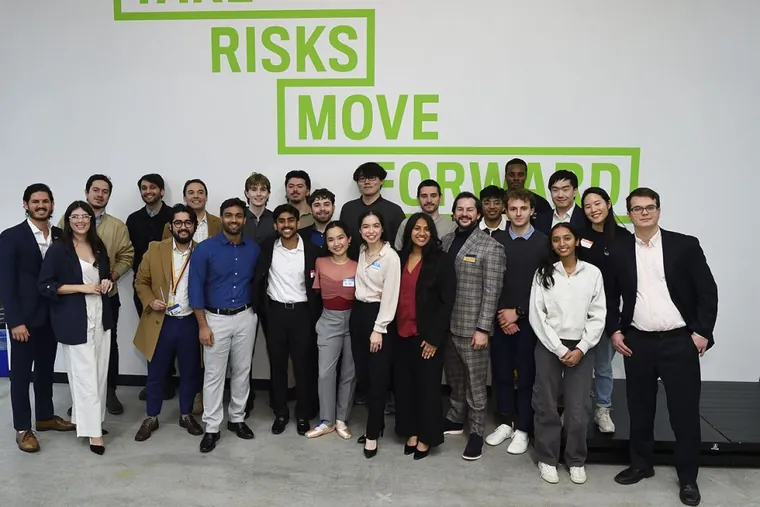
JHU Fuel Demo Day Win

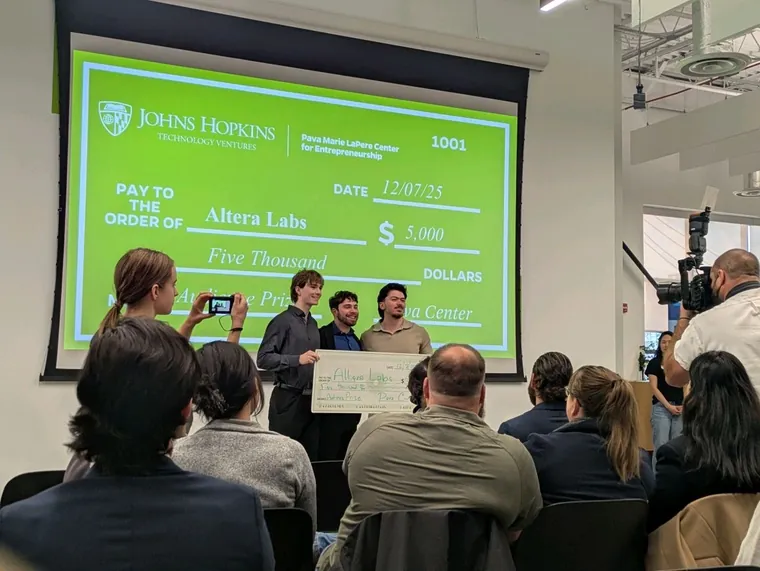
Won the $5,000 Audience Award at the 2025 Johns Hopkins Fuel Demo Day, an audience-voted win that showed strong student and faculty interest in the approach.

Read Article
JHU Fuel Demo Day Win
Pava Marie LaPere Center for Entrepreneurship
Nov 2025

Faculty Champion Endorsement

Secured endorsement from Prof. Kobe Marshall-Stevens (JHU Mathematics) as primary Faculty Champion for the TEDCO Baltimore Innovation Initiative.

"I strongly believe that the platform has potential to scale to large-scale classes with hundreds of students. I am hopeful that their platform will help to better shape university environments in the years to come."
Prof. Kobe Marshall-Stevens
Read Letter
Late 2025

The Strategic Pivot

Strategic shift from "Verifiable AI" (Lean 4) to State-Aware Cognitive Modeling. Prioritizing scalable mastery tracking over formal proof correctness.

Sep 2025

Pava Center Fuel Accelerator

Accepted into the JHU Pava Marie LaPere Center Fuel Accelerator. Selected as part of a high-growth cohort for ed-tech venture development.

2025 Fuel Cohort
Pava Marie LaPere Center for Entrepreneurship
May 2025

Research Foundation

CEO publishes "AI and Education: A Neurocognitive Perspective" at Johns Hopkins, establishing the scientific foundation for Altera's state-aware approach. The paper synthesizes research demonstrating a significant negative correlation between AI tool use and critical thinking (Gerlich, 2025).

Read Paper

Built by Altera Labs

Altera has raised nearly $60,000 in non-dilutive funding, led by a $49,838 TEDCO Baltimore Innovation Initiative award. Our founding team has raised over $190,000 for previous ventures, progressed through the JHU Pava Center's Spark and Fuel accelerators, and completed NSF I-Corps.

Peter Seelman

CEO
Peter Seelman

Johns Hopkins University

BS, Physics · BA, Mathematics

Leads product direction and institutional strategy. Background in AI systems at JHU APL and NASA, with a focus on turning technical research into tools for real classrooms.


Alex Kroumov

CFO, R&D Lead
Alex Kroumov

Johns Hopkins University

BS/MSE, Biomedical Engineering · BS, Applied Mathematics & Statistics

JHU BME and Applied Math researcher specializing in learning outcome modeling, neurocognitive data analysis, and statistical validation of product efficacy.

Akira Lonske

CTO, Lead Developer
Akira Lonske

Johns Hopkins University

BS Computer Science · BS Applied Mathematics & Statistics

Former Amazon software engineer with expertise in full-stack development, AI systems, and rigorous software engineering practices.

Advisory Board

Domain, institutional, and commercial validation from leading experts.

Dr. Kobe Marshall-Stevens

Mathematics Faculty, JHU

Faculty Champion & Pilot Data

Primary Faculty Champion providing direct access to our pilot cohort and the ground-truth data to validate our mastery model.

Dr. Richard Brown

Dr. Richard Brown

Director of Undergraduate Studies, JHU Mathematics

Institutional Adoption & Procurement

Our "voice of the customer," guiding procurement strategy and institutional adoption pathways.

Jennifer Harvey

Jennifer Harvey

Global Developer Marketing Manager, Google

Go-To-Market & Developer Ecosystem

15+ year Google veteran who scaled developer communities and startup accelerator programs globally. Brings proven GTM playbooks and direct access to Google's developer and startup networks.

Iris Gupta

Iris Gupta

Founder & CEO, ProCounsel

Fuel Program Advisor

JHU CS & Economics alum. Bisciotti Award winner and founder of ProCounsel, an AI-powered legal discovery platform.